- MIG
- TIG
- MMA
Welding Undercut: What Is It, What Causes It & How to Prevent It
Sarah Mazlin
15 September 2025
Welding undercut is a common weld defect that can happen regardless of the type of material you’re working on or the weld process you’re using. Undercut in a weld is never acceptable, as it can weaken the weld joint and needs to be fixed whenever it occurs.
There are a few ways it can be prevented or fixed, so we’ll cover what it is, how it’s caused and how you can get rid of it.
What Is Undercut?
Undercut in a weld is a groove or dip that forms along the toes or root of the weld bead where the base metal has melted away but hasn’t been filled in by filler material.
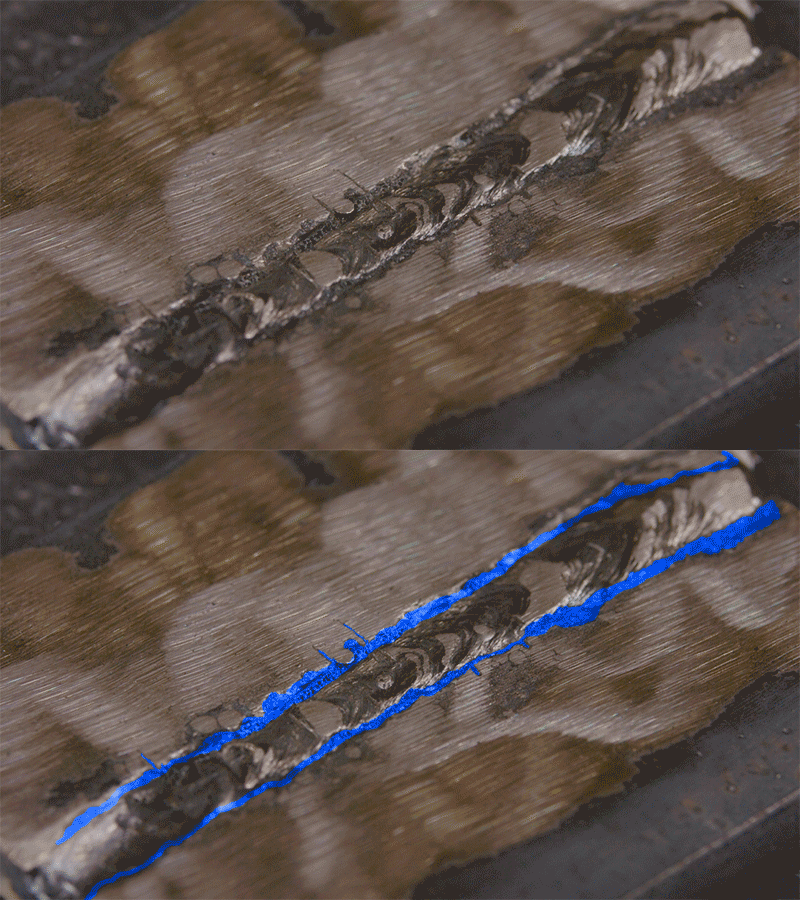
Undercut is a weld defect that is generally unacceptable. When your weld is undercut, it’s eating into your base metal’s thickness. This is often because of excessive heat or incorrect welding settings and technique.
If you’re welding on a 4mm plate, and you get undercut, that base plate is no longer 4mm where it’s undercut, which weakens the joint and surrounding area. There’s no longer as much metal at these points, which reduces its load-bearing capacity and its resistance to stress and fatigue. Undercut is usually the first place on a weld that will crack.
The groove formed by undercut can also work as a catch for contaminants like dirt or water, which speeds up the corrosion in these already weak areas and can cause premature failure.
Types of Undercut
There are two types of undercut you can get:
- External
- Internal
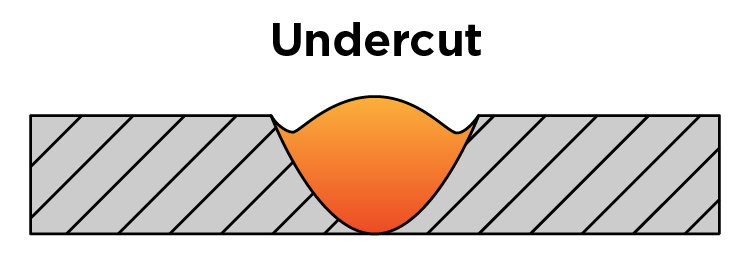
External undercut forms along the surface at the toes of the weld. It’s the most common type of undercut you can get. External undercut is typically what people refer to when talking about undercut.
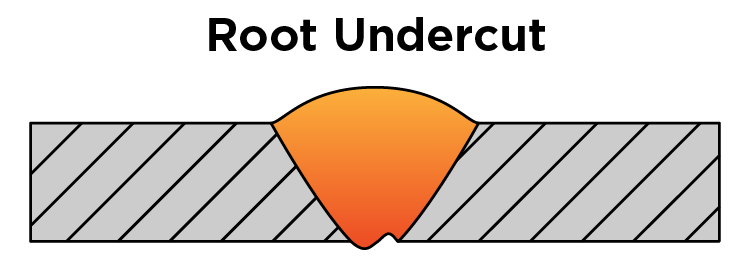
Internal undercut forms along the inside of the weld, at the root of the joint, which isn’t visible to the eye (unless you’re welding a butt joint). It is sometimes also referred to as root undercut.
What Causes Undercut?
There are several ways that you can get undercut in your weld, including:
Too Much Heat Input
One of the main causes of undercut is too high an amperage or too much voltage or wire feed speed. If you’re putting too much heat into the weld, the base metal is going to melt away faster than it can be filled in, leaving you with undercut at the edges of the weld.
Too Fast a Travel Speed
If you’re travelling along the weld joint too fast, your filler metal isn’t going to melt in properly. By moving too fast, your filler doesn’t get a chance to wash into the toes of the weld and fill the space being welded. If your weld isn’t properly filled, you’re going to be left with undercut.
Too Long an Arc Length
Holding your torch or electrode too far away from your workpiece will make your arc length too long.
An arc length that is too long makes it less concentrated in the joint, which can cause it to wash the puddle. That means the weld pool can become wider, spreading the heat further (but unevenly). A wider weld pool will melt more of the base metal but leave it unfilled, as there’s not enough filler being added, and will leave you with undercut.
Using the Wrong Angle
If you’re welding at the wrong work or travel angle, you’re going to have issues, including undercut.
Welding at too steep or too shallow an angle means your arc isn’t going to be evenly directed at the joint. Parts of it will melt more or faster than others, leaving you with undercut along the edges.
Using the Wrong Filler Material
Using a filler material that doesn’t match your base metal, among other things, will cause problems when trying to get them to melt into each other. If your filler metal doesn’t have similar thermal properties to your base melt, they’ll melt at different rates and likely won’t tie together, causing undercut.
Using the Wrong Size Filler Material
Whether it’s too large or too small, using a filler wire, rod, or electrode that’s the wrong size for your material thickness can lead to undercutting.
If your filler is too big, the excess material accumulates as a convex weld bead that doesn’t tie into the toes of the weld (known as overlap). You’ll also likely have your amperage turned up too high to be able to melt it. Both of these will contribute to the forming of undercut.
If your filler is too small, there won’t be enough material available to fill the joint, and you’ll get an undercut weld.
Excessive or Incorrect Weaving
Weaving a weld isn’t always necessary, and when done incorrectly, it can cause problems like undercut.
One of the most common weaving techniques is to move the torch in a zigzag along the joint. The issue occurs if this motion is done too quickly, especially if at the edges of the joint for long enough.
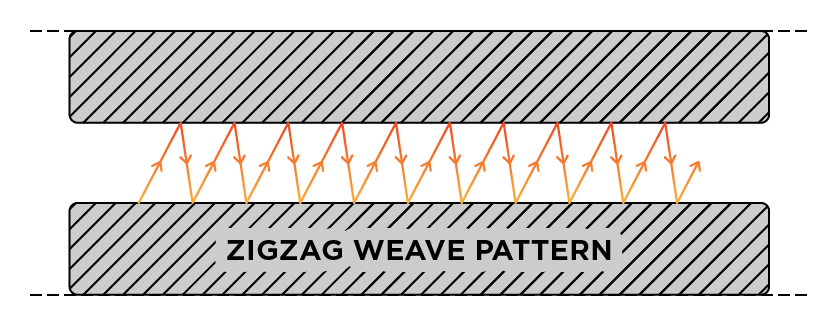
If there isn’t a long enough pause at the toes of the weld while weaving, the base metal will melt, but the filler metal doesn’t have enough time to fill the joint back in, leaving you with undercut.
Poor Joint Preparation
Improper metal preparation, like not cleaning the grime and dirt from your base metal, or a poor joint fit up, can lead to undercut.
They can impact the penetration and fusion of your weld pool as it sucks in contaminants, interrupting it from properly wetting in and leaving you with undercut.
How to Prevent Undercut in Your Welds
That’s about all the ways you can end up with undercut in your weld, but there are ways to prevent all of them.
Use the Right Amperage/Voltage/Wire Feed Speed
Adjust your amperage or voltage/wire feed speed settings to match what’s needed for your material thickness. If you’re getting long runs of undercut, your heat is likely too high. Turn your volts down to lower the heat input or turn your wire feed speed up.
Most MIG welders, including UNMIG machines, come with a settings chart installed in the door, giving you a good starting point.
You can also check out the Ultimate Welding Guide for full settings guides across TIG and stick welding if you’re not sure where to start.
Travel at a Good Pace
You don’t want to travel too fast, as this won’t give your weld time to fill in, causing undercut. Travelling too slow will give you excessive weld buildup, plus it’ll likely burn through on thinner material.
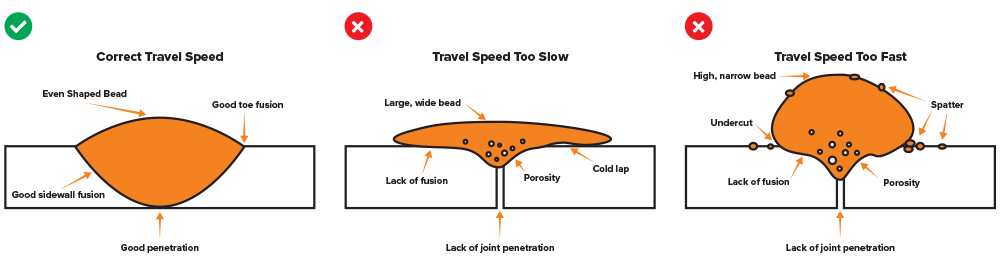
You want to find a speed for your weld that lets your filler metal fill the joint properly and keep your travel speed consistent. Don’t slow down and speed up as you go.
Tighten Your Arc Length
Too long an arc will give you excessive spatter and undercut, so you want to keep your arc length short as you weld, but not too short. Otherwise, you could stick your electrode.
A good rule of thumb (when stick welding) is that your arc length shouldn’t be longer than your electrode diameter. If you’re using a 2.6mm electrode, your arc length shouldn’t be longer than 3mm.
Once your arc length is correct, you want to maintain it the whole way along the joint.
Use the Right Torch Angle
You want to use the right work angle and travel angle while welding. Your work angle is the angle of your torch in relation to the joint, and it will depend on the joint you’re working on.
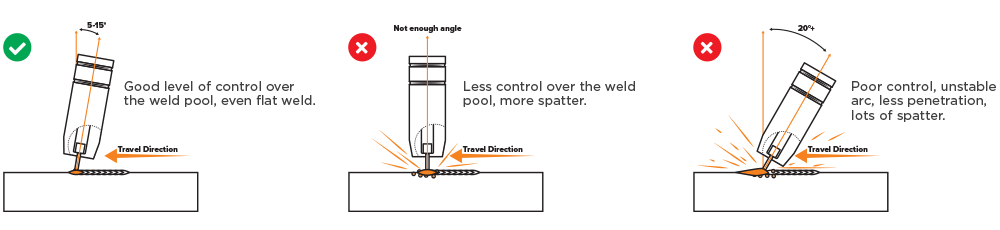
Your travel angle is the angle your torch travels at.
If you’re welding with gas, you’ll want to travel at a pushing angle (torch over the weld pool pushing towards the unmelted metal).
If you’re welding with gasless, you’ll want to travel at a pulling angle (torch in front of the weld pool and dragging towards the unmelted metal).
You want to keep your torch at a 10° to 15° angle, whether you’re pushing or pulling. If your angle becomes too deep or parallel with the metal you’re welding, you increase the spatter amount and decrease penetration.
For example, if you’re welding a fillet joint with a standard steel wire, your torch will be angled into it at a 45° angle, and your travel angle will be in a pushing direction.
You also want to make sure that while your angle is correct, your arc is also centred in the joint and doesn’t favour one side or the other.
Use the Right Type & Size Filler Material
Make sure you choose a filler material that matches your base material and will weld together without issue. You generally want to match (or get as close to) the metal grade and tensile strength to avoid running into problems.
You also want to select a filler material that’s the right size. There should be enough metal deposited to fill the weld up without it being so thick that your amperage needs to be cranked up just to get it to melt.
Perfect Your Technique
For the most part, a stringer bead is all that’s necessary while welding, so you won’t need to worry about weaving or torch manipulation.
However, in those instances where you’ll need to do some sort of weaving (e.g., vertical up), make sure to pause at the edges of the weld. You don’t want the puddle to build up in the centre while leaving the edges of the weld empty.
Properly Prep Your Metal
As with all welding, make sure your base metal has been properly cleaned of contaminants like dirt, oil, grease, rust, paint, etc., and that your joint edges have been deburred and properly lined up for the best results.
How to Fix Undercut
There are two ways you can fix an undercut weld.
The first way is to fill it in with another weld bead. Undercut in a weld is usually narrow and long, so you can simply lay another weld bead down over the top of the defect to restore the joint’s metal and strength.
The second way is to remove the previous weld and start again. This might not be an option if you’re working with thinner materials, as they won’t withstand the loss in strength.
If you’re working on a crucial application, consult the welding engineer or supervisor to determine how best to remedy the situation.
Undercut vs Underfill
Though they sound the same, undercut and underfill are two different weld defects.
Undercut: A groove or dip that forms along the toes or root of the weld bead where the base metal has melted away but hasn’t been filled in.
Underfill: A dip or depression in the weld bead which leaves the face of the weld below the surface level of the base metal because it hasn’t been filled properly.
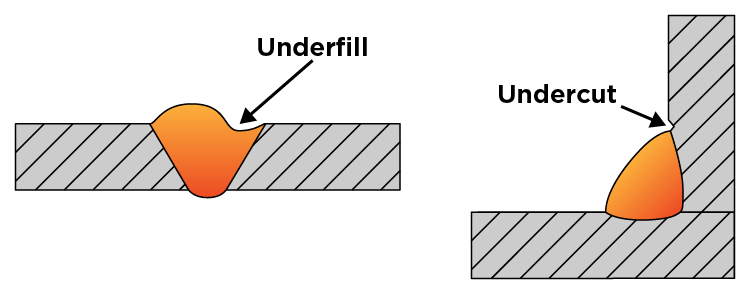
Undercut generally occurs in the base metal next to the weld bead, while underfill occurs in the weld metal itself.
Undercut vs Lack of Fusion
Like underfill, a lack of fusion is a separate weld defect that can occur in your weld that is different from undercut.
While undercutting eats away at the base metal and doesn’t fill it back in, a lack of fusion occurs when the weld metal doesn’t fuse with the base metal. You can also get a lack of fusion between multi-pass weld beads. It often leaves gaps along the edge of the weld and is usually characterised by a high crown weld bead.
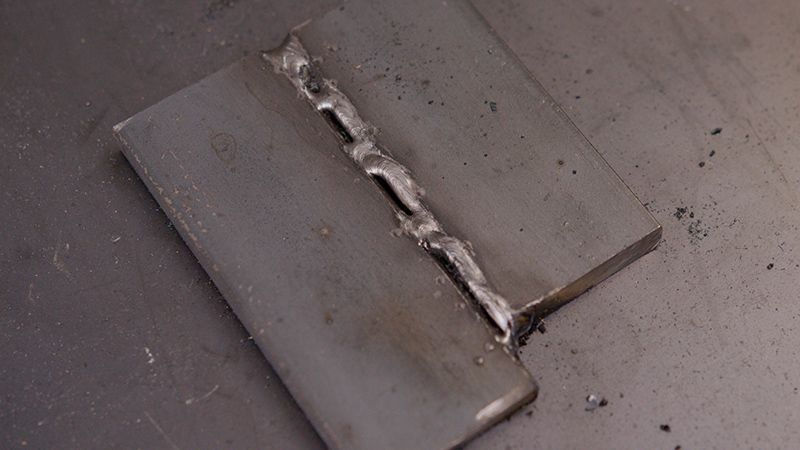
Even if you do everything possible to prevent it, you may still run into undercut on your weld. Once you’ve got undercut, you’ll need to remove it.
Knowing what might have caused the undercut and how to stop it for the next weld is a valuable skill to have. That, and practice, are the best ways to keep your welds undercut free.
Get The Free Ultimate Welding Guide!
Welding tutorials, tips, and settings in one eBook.